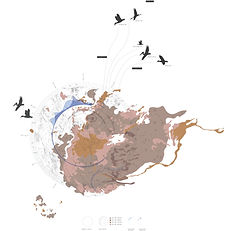
On Thirst and Mirage: Multilayered Spatial Research on the Dried Hamoun Wetlands in the Iranian-Afghan
Desert Border Landscape
Research Project
Year:
2024-2025
Author(s):
This project investigates the complex relationship between environmental degradation, bordering processes, political tension, and indigenous techniques in desert landscapes surrounding the dried basin of the Hamoun Wetlands in Sistan, located across the Iran-Afghanistan border. It critically examines the resilience of practices of the inhabitants who adhere to the desert and what it offers. Studying these practices sheds light on traditional governance systems, vernacular crafts, and techniques for managing the entangled milieus of water, soil, and air that have shaped deserts through weathering.
Historically, the Hamoun wetlands were a significant inland delta fed by Helmand and other seasonal rivers flowing from Afghan territory, supporting ancient civilizations and thriving biodiversity. The wetlands were home to diverse forms of life- settled communities, villages, and cities, as well as various nomadic life forms, which inhabited all marginal possibilities of such an ecosystem in short and longer distances. However, bordering demarcations in the late 19th century, including British colonial interventions and the technocratic modernization of two countries, divided these wetlands and disrupted their ecosystems, leading to geopolitical disputes, ecological disentanglement, and the gradual degradation of the wetlands and, with it, the indigenous practices. This work presents a multi-layered image of Sistan’s territory and contributes to a broader discourse on climate resilience, scarcity, and transboundary cooperation in a region long marginalized and understudied.
Through spatial analysis and mapping, the research interrogates the archival gaps to narrate an alternative story beyond mere loss and violence, to build shared frameworks, on the one hand, to support local efforts resisting the ongoing environmental injustice and, on the other hand, to shift the discourse on transboundary disputes from a focus on security and control towards shared heritage, ecological continuity, and collective concerns.
This proposal builds on the ongoing research funded by the Climate Action Program at TU Delft (2024-25) and is based on collaboration between experts and local communities.
https://www.tudelft.nl/climate-action/seed-fund-call/seed-fund-grants-2023-november